

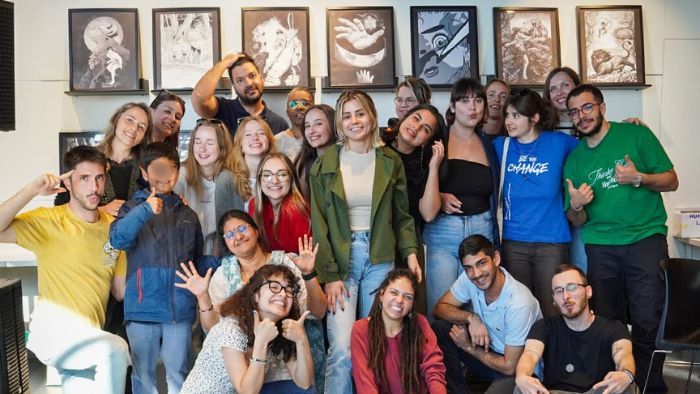
From March 21 to 31, our volunteers Cristina, Daisy, and Luciana took part in the “Home Away from Home” project—a training course designed to provide 24 young activists and youth workers with practical tools to build more inclusive local communities, especially in the context of forced migration.
The training course, organized by the association Agora Aveiro and led with care and attention by Nataša and Jasna, was structured to encourage the active involvement of all participants. From day one, daily roles—ranging from reporters to energizers—were assigned to promote a sense of shared responsibility, mutual care, and group spirit.
Through non-formal education methodologies, participants explored creative approaches and awareness-raising practices, directly experiencing the power of collective engagement.
The proposed activities, the relationships formed, and the exchange of ideas led to the creation of several creative projects. The group split into three workshops: “Human Library,” “Theatre of the Oppressed,” and “Guerrilla Marketing,” each aiming to promote social inclusion through alternative forms of communication.
The Human Library provided a space for active listening and dialogue: among the five “human books” was our volunteer Luciana, who shared her migration story from Peru.
The Guerrilla Marketing group was responsible for promoting the Human Library event, opting for a visual and provocative approach through a performance centered on the “death of human values” and by installing mirrors with anti-stereotype messages in Aveiro’s main square.


“It was an experience I will always remember: I learned many resources I will use in my future career. The environment that was created was truly beautiful—one of sharing, open dialogue, empathy, and sensitivity. It was also a chance to learn about the experiences of people from other countries who work daily in this field. A particularly touching experience for me was participating in the Human Library activity, in the role of a “book”: I shared my migration story and listened to those of others in a real exchange of emotions, life experiences, and perspectives. I had the honor of sharing this experience with other “human books” from Iran, India, Greece, and the United States. It was a moment that deeply enriched me, both as a person and as an active citizen.”
Luciana
Meanwhile, Daisy and Cristina took part in the “Theatre of the Oppressed” workshop, where theater techniques were used to create a powerful space for sharing and vulnerability, fostering empathy among participants.
Inspired by the documentary “Shadow Game”, the group created a performance about unaccompanied minors crossing the Balkan route, generating a deep and critical reflection between actors and spectators.
“The greatest emotion I felt was a pleasant surprise. Since this was my first Erasmus project, I really didn’t know what to expect. All I felt was growing excitement for being selected and a bit of nervousness about what might happen. I often asked myself: “How will I present myself? Will I be enough?” I’m truly happy to have found such a welcoming environment. Both the organizers and the participants created a space where I wasn’t afraid to express myself and share my opinions. And for everything I gave, I received back so much more—deeply and genuinely. The highlight was the Theatre of the Oppressed: what a powerful tool to convey the struggles of migration, involving both audience and performers! I found myself transformed—not only by the act of creating but also by the act of sharing. I’m proud of the version of myself that emerged from this project and excited about what she will do next!”
Daisy
“This was the first time I took part in an Erasmus+ project, and despite my initial expectations, I recognize it was an important opportunity for personal growth. It wasn’t easy, but the kindness and openness of the people I met gave me courage. For me, the “Home Away from Home” project was exactly that: connecting with others, building bridges, challenging myself, and stepping out of my comfort zone to strengthen our activism. I had the opportunity to connect with personal stories and discuss current political issues openly, hearing firsthand from those directly affected—often realizing how differently these events are portrayed by national media. Considering how in Italian public opinion political issues often last only as long as an Instagram reel, seeing my peers concerned about protests in their home countries gave me a sense of hope and a drive to keep fighting. Taking part in the “Theatre of the Oppressed” workshop was especially meaningful: I’ve acted for years, but I had never experienced theater as an activist tool. It’s definitely something I’ll incorporate into my future work.”
Cristina
Over the ten days, participants engaged in various activities, moments of exchange, and meetings with local organizations working in the field of inclusion and sustainability, such as CAIS 1515, Orbis, Mo Na Mon, and Casa Vera Cruz.
For our volunteers, this project was an extraordinary opportunity not only to learn new tools to bring about change in our communities but also to share their experiences and embrace those of others. They had the chance to connect with many young Europeans who share the same values—especially crucial in times like these, when governments are more inclined to build walls than bridges.
The training course was organized by the Portuguese association Agora Aveiro, funded by the Erasmus+ program in collaboration with five partner organizations: Popoli Insieme (Italy); Belen Kaymakamligi (Turkey); Level Up (Greece); Becej Youth Association (Serbia); iDEMO (Croatia); and Red Incola (Spain).


