

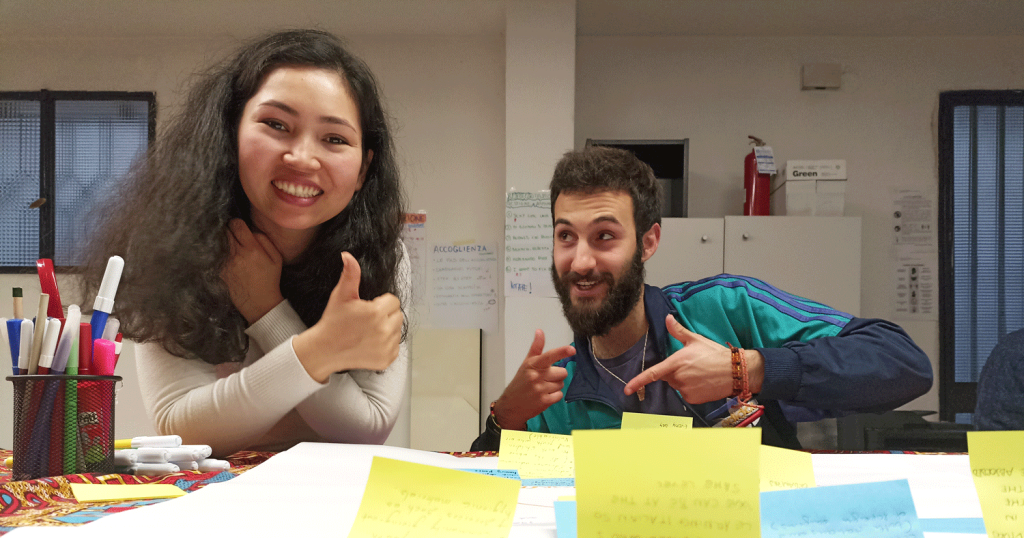
For many refugee students, gaining access to university is only the first step: the real challenge is finding housing and feeling part of a community. The Arrupe Project responds to this need, and Elisa Gamba, a member of our board, discusses it in her first scientific article published in the Epale Journal.
We’re happy to share some exciting news: Elisa Gamba, board member and PhD candidate in Human Rights, has published her first scientific article focusing on the Arrupe Project. Her paper, titled “Per una reale inclusione degli studenti rifugiati: il progetto Arrupe come best practice per le università italiane”, appears in Issue 16 of the Epale Journal on Adult Learning and Continuing Education, dedicated to the theme of lifelong learning for the inclusion and cultural integration of refugees.
In her article, Elisa explores the Arrupe project model as a concrete response to the housing difficulties faced by refugee students. For many of them, the joy of receiving a scholarship is quickly overshadowed by the stress and difficulty of finding accommodation, which makes it harder to integrate into the new social context and to build local networks.
As the author emphasizes, “the real integration of refugee students does not end with the awarding of a scholarship; it requires continuous commitment to provide academic, psychological, and social support.” At the heart of the Arrupe Project is the creation of a shared living experience, where students can feel like protagonists in a personal and collective educational journey, care for their inner well-being, and build their future by embracing the richness of dialogue and encounter with others.
Another key point from the article underlines that “ensuring access to higher education for refugees means not only recognizing a fundamental right, but also creating the conditions for personal and social development that foster inclusion and active participation.” This approach aligns perfectly with our vision: to create spaces where knowledge and personal stories are acknowledged and valued.
Padua, a city with a long-standing tradition of hospitality, provides the ideal setting for the Arrupe Project. In line with the international 15by30 campaign—which aims to increase the global enrollment rate of refugees in higher education to 15% by 2030—Popoli Insieme, partner of the UNICORE program, contributes to this global inclusion goal by building bridges between local support and international challenges.
We are proud to see Elisa’s work recognized in a prestigious academic journal, and we thank her for giving voice—through her research—to the experiences of so many refugee students.
The Arrupe Project is made possible thanks to the collaboration with Collegio Universitario Sacra Famiglia, Antonianum – Centro Ignaziano di Cultura e Formazione, Residenza Messori
For the academic year 2024/2025, the project is supported by Fondazione Cariparo and UniCredit.
